


Subscribe to our mailing list.
All Blog Posts With Tag: Benjamin Breckinridge Warfield
J. Gresham Machen’s racist 1913 letter and agenda (and a defense of Karl Barth) (September 5, 2018)
The revelation of J Gresham Machen's 1913 racist letter to his mother and agenda at Princeton Seminary has caused defenders of Machen to justify Machen by making personal attacks on Karl Barth. I'd like to share a brief response. The original source of J. Gresham Machen's racist comments and agenda […]
The Errors of Inerrancy: #1 The Church has never possessed an inerrant Bible (September 27, 2016)
[The Errors of Inerrancy: A ten-part series on why Biblical Inerrancy censors the Scriptures and divides Evangelicals.]
The Errors of Inerrancy: #1. The Church has never possessed an inerrant Bible.
No one person or church has ever possessed an inerrant Bible, because Biblical Inerrancy "strictly speaking, applies only to the autographic text of Scripture" […]
George Hunsinger on the Pathogenicity of Rationalistic Calvinism (July 11, 2015)
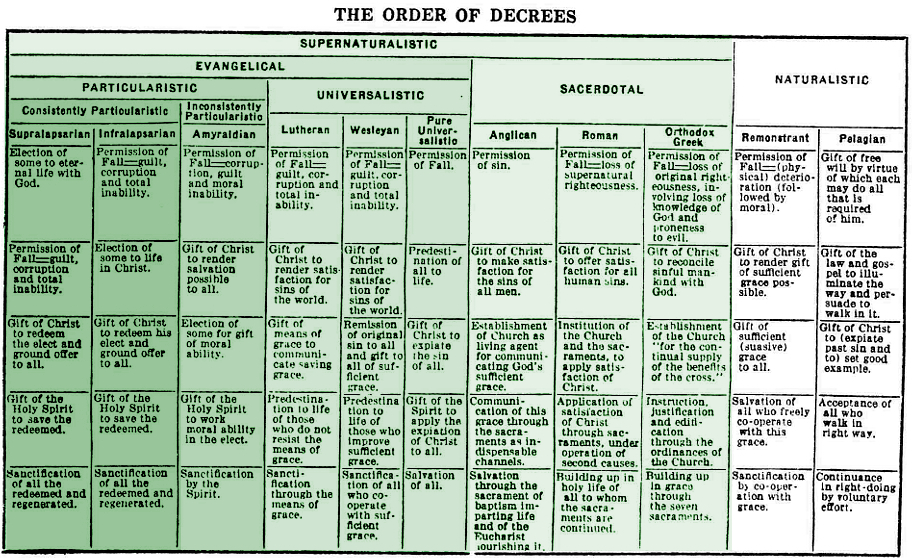
B. B. Warfield's famous "The Order of Decrees" chart from The Plan of Salvation is figured above. I've colorized the chart so that the darkest swim lanes are those most endorsed by B. B. Warfield (and most exemplifying Rationalistic Calvinism.)
George Hunsinger referenced B. B. Warfield's famous "Orders of Decrees" chart (see […]
C.H. Dodd vs Michael Horton on Plenary Verbal Inspiration (December 19, 2014)

Michael Horton's The Christian Faith and C.H. Dodd's The Authority of the Bible
The following is a debate been Michael Horton and C.H. Dodd on Plenary Verbal Inspiration of the Holy Scriptures.
In Michael Horton's The Christian Faith, he perceives B.B. Warfield's The Inspiration and Authority of the Bible as the undisputed champion of the […]
Gerard Dou (source:wikipedia)
Jack Rogers and Donald McKim's historical analysis of the Doctrine of the Inspiration of Scriptures, The Authority and Inspiration of the Bible (AIB), created a firestorm in the late 1970's due its conclusion that the Reformers' Doctrine of Inspiration (exemplified by John Calvin and the Westminster Confession of Faith) was […]
Herman Bavinck on the Inspired Scripture’s Capacity for Errors (September 23, 2014)
Herman Bavinck (source: wikipedia)
The Dutch Calvinists, such as Abraham Kuyper, Herman Bavinck, and G.C. Berkouwer, were not paralyzed by the mechanical theories of the Inspiration of Scriptures as their American Calvinist counterparts at old Princeton did with Inerrancy, including Charles Hodge, B.B. Warfield and A.A. Hodge. In the following brilliant selection from […]
Sign of the Gospel: Why my children are being baptized (October 25, 2013)
My family has been members for years at Mars Hill Church. I served there in various ministries, as a Deacon, and for the past two years as a Pastor. This summer, we left Mars Hill to join Trinitas Church, a church plant within the Presbyterian Church in America (PCA). Although […]
John Calvin’s Epidemiological Method [Institutes I.i] (February 14, 2013)
The opening sentences of the Institutes of the Christian Religion are almost as famous as the entire book itself,
"Nearly all the wisdom we posses, that is to say, true and sound wisdom, consists of two parts: the knowledge of God and of ourselves. But, while joined by many bonds, which one […]
Ten Theologians That Have Influenced Me (2011) (February 22, 2011)
Here is my "Top Ten List of Most Influential Theologians." I'll quickly stress that the following theologians have influenced me the most, and only contains books that I've read too. I've excluded authors, if I've only read one of their books too. Some...
Benjamin Breckinridge Warfield: An Introduction (November 14, 2009)
Benjamin Breckinridge Warfield (1851 - 1921) or commonly known as B. B. Warfield was an amazing American Presbyterian minister and prolific writer that you need to get to know better. I found four volumes of B. B. Warfield's "works" at half price books...
Related: b.b. warfield, Benjamin Breckinridge Warfield